
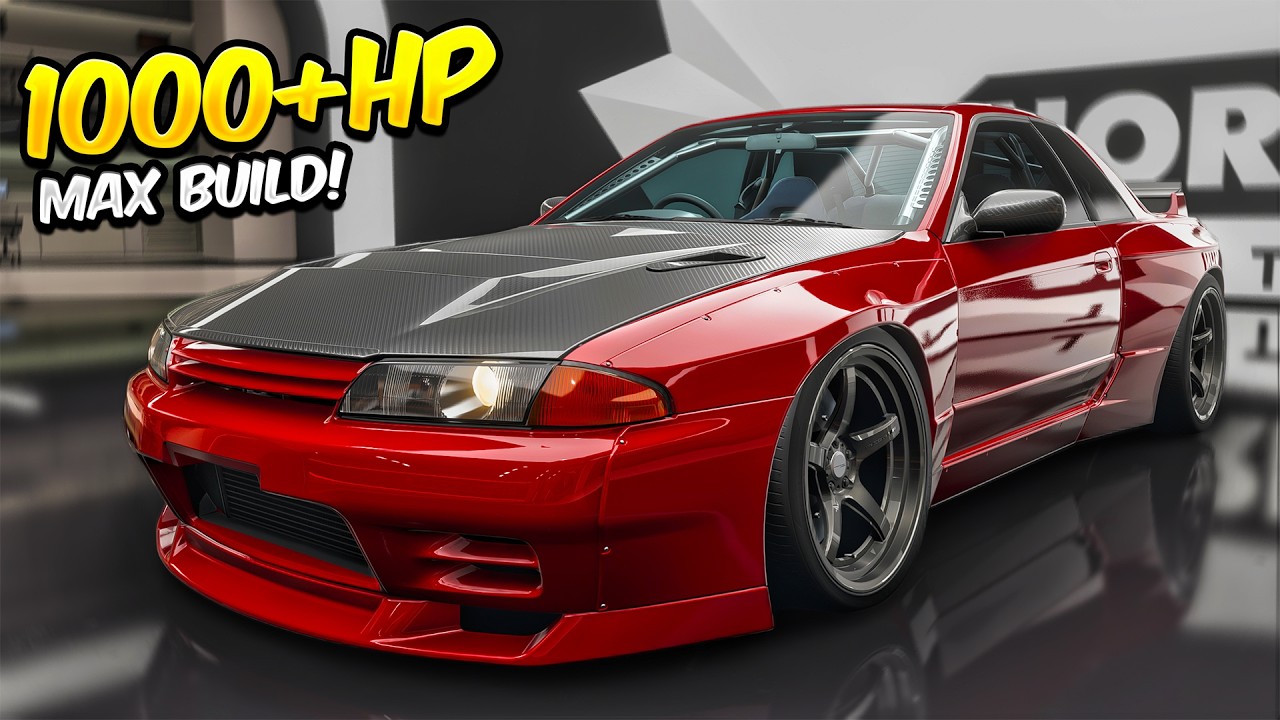
Forza Horizon 6 is already shaping up to continue the series tradition of blending iconic automotive heritage with modern driving physics and customization depth. One of the earliest standout additions arriving through the Car Pass is the legendary Nissan Skyline R32 GTR (K-Sonic-inspired racing livery)—a machine that immediately captures attention despite not explicitly branding its famous motorsport identity.
This article breaks down the car’s arrival, performance behavior, tuning progression, and why it represents one of the most interesting early collectible vehicles in FH6.
First Car Pass Drop: A Racing Icon Reborn
The first Car Pass release introduces a heavily motorsport-focused version of the R32 GTR, recognizable instantly through its racing aesthetic—even if the branding is absent in-game.
Key design and build highlights
| Feature | Description |
| Base model | Nissan Skyline R32 GTR |
| Drivetrain | AWD |
| Engine | RB-series inline-6 (~2.6L) |
| Build style | Group A/JTC racing spec |
| Weight | ~1,261 kg |
| Power output | ~641 hp |
| Torque | ~667 Nm |
| Visual cues | Side exit exhaust, cage, stripped interior, center-lock wheels |
This is not a road-focused Skyline—it is a full touring car build, echoing Japan’s Group A racing era where the R32 earned its “Godzilla” reputation.
Driving Character: Balanced AWD With Race Intent
Out of the box, the car immediately feels stable and predictable, which is consistent with its AWD touring setup.
Handling traits (stock configuration)
- Strong mid-corner stability
- Minimal oversteer unless provoked
- Slight understeer at high entry speed
- Excellent braking performance
- Strong traction on corner exit
The key takeaway is balance: it is not a drift-heavy Skyline, nor an aggressive oversteer monster. Instead, it behaves like a precision time-attack platform with built-in forgiveness.
Early Performance Testing (Rivals Sprint Example)
A first-run sprint event on a mixed-corner circuit revealed the car’s baseline capability.
Initial run result snapshot
| Metric | Result |
| Event type | Sprint / Rivals |
| Track style | Mixed corners, limited straights |
| Clean lap performance | Competitive but not meta-tier |
| Errors | Minor wall scrape penalty |
| Learning factor | High (new track adaptation required) |
Even with limited familiarity, the car delivered a competitive baseline lap, indicating strong potential once tuned.
Tuning Progression: From Stable to Sharp
The real depth of the R32 appears when tuning begins. Rather than pushing it into extreme builds, the focus stayed on S2-class refinement rather than X-class conversion.
Key tuning adjustments made
- Aero balance adjustments for stability
- Differential tuning for rotation
- Slight power increases via restrictor adjustments
- Suspension refinement for corner entry response
- Minor gear ratio experimentation
Handling Evolution: Before vs After Tune
| Trait | Stock | Tuned |
| Turn-in response | Smooth, slightly safe | Sharper, more aggressive |
| Oversteer | Minimal | Controlled and intentional |
| Understeer | Occasional | Nearly eliminated |
| Corner exit | Stable | More rotation-based |
| Driver confidence | High | Higher (with skill input) |
The tuning direction clearly shifted the car from a “safe AWD racer” into a rotational grip machine that rewards throttle discipline.
Power vs Grip Trade-Off Analysis
One of the most important tuning decisions involved tire width and grip scaling.
| Setup | Lateral Grip | Weight impact | Behavior |
| Stock tires | Moderate | Lightest | Balanced feel |
| Wider race tires | Higher | +weight penalty | Stronger grip, more planted |
Interestingly, the analysis shows diminishing returns: while grip increases significantly, weight gain slightly offsets responsiveness, meaning optimal setups depend heavily on track type.
Competitive Potential in FH6 Meta
While the R32 GTR is not positioned as an outright meta vehicle for leaderboard domination, it sits in a strong “technical competitive” bracket.
Where it performs best
- Technical sprint circuits
- Medium-speed circuit racing
- Time attack practice sessions
- AWD-friendly seasonal events
Where it struggles
- High-speed X-class drag meta builds
- Pure straight-line optimization builds
- Extreme leaderboard min-max setups
This makes it a driver-focused performance car rather than a leaderboard exploit vehicle.
Build Philosophy: Why This Skyline Feels Different
A major design strength of this Car Pass addition is its versatility without forcing specialization.
Players can:
- Keep it AWD and balanced
- Push it toward mild oversteer setups
- Convert toward higher power S2 builds
- Preserve its touring car identity
It avoids the common FH problem where a car becomes “one correct build only.”
Forza Horizon 6 Credits Economy Context
As Car Pass content expands, progression naturally ties into the broader upgrade and acquisition loop. Vehicles like this Skyline often become long-term garage staples rather than disposable unlocks, which increases demand for tuning, upgrades, and additional builds.
This is where systems like Forza Horizon 6 Credits become relevant for players who want to accelerate experimentation, expand garages, or test multiple builds without repetitive grind cycles.
Conclusion: A Collector-Grade Performance Platform
The Nissan Skyline R32 GTR Car Pass release in Forza Horizon 6 stands out not because it is the fastest car available, but because it captures something more important: authentic motorsport identity combined with flexible tuning depth.
It rewards:
- Clean driving technique
- Incremental tuning refinement
- Understanding AWD dynamics
- Track learning and consistency
For collectors and tuning-focused players, it is one of the most meaningful early additions to FH6’s evolving car list.